

JUSTICE IN BALANCE
Democracy, Rule of Law, and the European Court of Human Rights
Established as a post–World War II response to conflict and fascism, the European Court of Human Rights is routinely characterized as the most successful human rights institution in the world. Based in Strasbourg, France, its jurisdiction extends to over 700 million people on European soil across the 46 Council of Europe member countries. The Court is the crown jewel of the Council, an international organization dedicated to human rights, democracy, and the rule of law. And yet, for years, European institutions have been haunted by the specter of failure. In the shadow of rising populism, inequality, and war, faith in democracy and the rule of law has been shaken to its core. Drawing on extensive fieldwork conducted over eight years with human rights advocates, lawyers, and judges at the European Court of Human Rights, this book asks: What kind of justice is possible through law?
Drawing on participant observation, in-depth interviews, and archival research, Jessica Greenberg tracks two paradoxical experiences of the European human rights system and the Court: on the one hand, the Court as a bureaucratic “machine”; on the other, the Court as the “conscience of Europe.” She argues that human rights frameworks fuel imaginative approaches to social change and compel legal actors to creatively navigate institutions through advocacy, persuasion, and innovative interpretation of what the law is and what it should be.
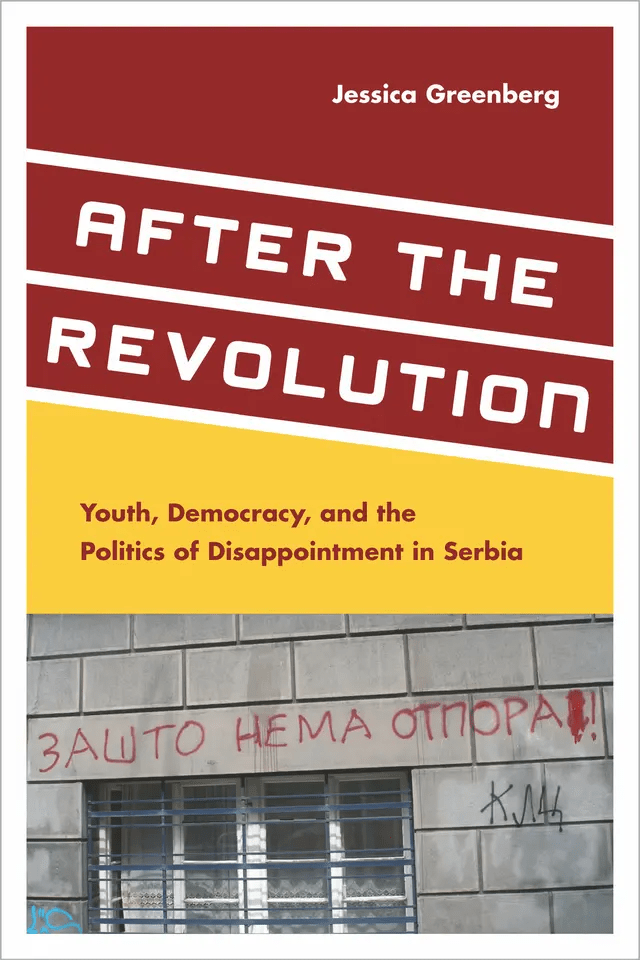
After the Revolution
Youth, Democracy, and the Politics of Disappointment in Serbia
What happens to student activism once mass protests have disappeared from view, and youth no longer embody the political frustrations and hopes of a nation? After the Revolution chronicles the lives of student activists as they confront the possibilities and disappointments of democracy in the shadow of the recent revolution in Serbia. Greenberg’s narrative highlights the stories of young student activists as they seek to define their role and articulate a new form of legitimate political activity, post-socialism.
When student activists in Serbia helped topple dictator Slobodan Milosevic on October 5, 2000, they unexpectedly found that the post-revolutionary period brought even greater problems. How do you actually live and practice democracy in the wake of war and the shadow of a recent revolution? How do young Serbians attempt to translate the energy and excitement generated by wide scale mobilization into the slow work of building democratic institutions? Greenberg navigates through the ranks of student organizations as they transition their activism from the streets back into the halls of the university. In exploring the everyday practices of student activists—their triumphs and frustrations—After the Revolution argues that disappointment is not a failure of democracy but a fundamental feature of how people live and practice it. This fascinating book develops a critical vocabulary for the social life of disappointment with the aim of helping citizens, scholars, and policymakers worldwide escape the trap of framing new democracies as doomed to failure.
 Jessica Greenberg